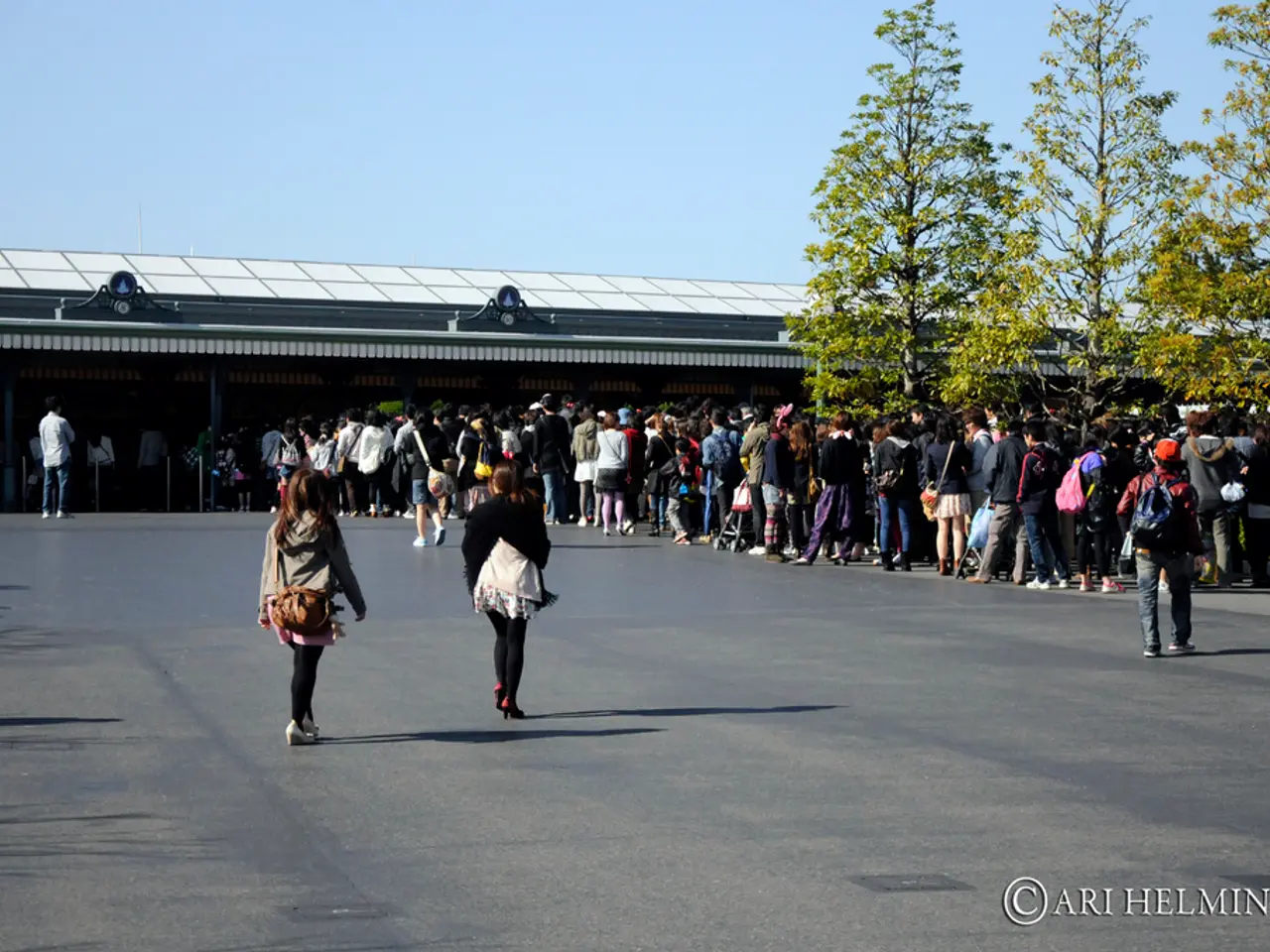
Queuing at a Safe Distance: Two Meters of Social Distancing May Not Always Prevent Overlaps
The fluid dynamics of air are complex, and general intuition often misleads, even for something as simple as standing in a line. A new study conducted by University of Massachusetts Amherst students Ruixi Lou and Milo Van Mooy has delved into the origins of the "6 feet" social distancing advice, revealing that room temperature, walking speed, and ventilation play significant roles in determining social distancing requirements to prevent disease transmission in a queue.
The study, published open access in Science Advances, suggests that at room temperature of 28°C (82°F), virus-carrying aerosols can hover just high enough to be inhaled during social distancing in a queue. This finding underscores the importance of temperature in determining how far aerosols carrying viruses travel.
Indoor airflow patterns dominate aerosol spread, often making the traditional 6-foot (about 2 meters) distance ineffective, especially in moving lines or dynamic indoor environments where air currents can trap infectious particles at breathing height. Walking speed affects air currents: faster speeds create stronger downward airflow that can push infectious particles away from breathing zones, potentially reducing risk. However, typical slow stop-and-go walking indoors tends to generate circulation patterns that trap infectious particles near the source, increasing exposure risk.
Room temperature interacts with air flow: when the temperature allows the buoyancy of warm exhaled breath to counteract the downward airflow caused by walking, infectious particles hover longer at breathing level, increasing infection risk. Proper ventilation reducing CO₂ and particulate levels is critical. Poor ventilation can increase airborne disease transmission by allowing infectious particles to accumulate, regardless of physical distancing.
The researchers' approach is significant because it more accurately represents real-life queuing scenarios. They used 3D printed human-shaped models and a conveyor belt to simulate a queuing situation, releasing colored droplets to represent breathing, coughs, and sneezes.
The findings of this study indicate that another pandemic might require revising current social distancing advice. Public health guidelines should take space and time into account to account for these factors. However, any model can be incomplete, and without real people involved, answers can never be definitive.
The benefits of wearing masks, disinfecting surfaces, and the risk of transmission outdoors were initially underestimated during the COVID-19 outbreak. As we continue to navigate the pandemic and prepare for future health crises, understanding the complexities of air dynamics in indoor queues is crucial to developing effective public health measures.
References:
[1] Lou, R., & Van Mooy, M. (2021). The impact of walking speed, room temperature, and ventilation on disease transmission in a queue. Science Advances, 7(13), eabg5295.
[3] Prather, K. A., et al. (2020). Global air pollution states and trends between 1998 and 2017. Nature, 577(7789), 337-341.
- The study conducted by Ruixi Lou and Milo Van Mooy at the University of Massachusetts Amherst sheds light on the significance of room temperature in determining the spread of aerosols carrying viruses during social distancing in a queue.
- The research published in Science Advances reveals that indoor airflow patterns can make the traditional 6-foot (about 2 meters) social distancing advice ineffective, particularly in dynamic indoor environments.
- The findings suggest that public health guidelines should consider space, time, and industry-specific factors to develop effective health-and-wellness measures in preventing disease transmission in queues and other moving lines.
- Understanding the complexities of air dynamics in indoor queues, as evidenced in this research, is essential for more accurate public health advice and policies in dealing with pandemics and future health crises.